
Binghamton University is strengthening its global partnerships in pharmacy education through new collaborations with institutions in India.
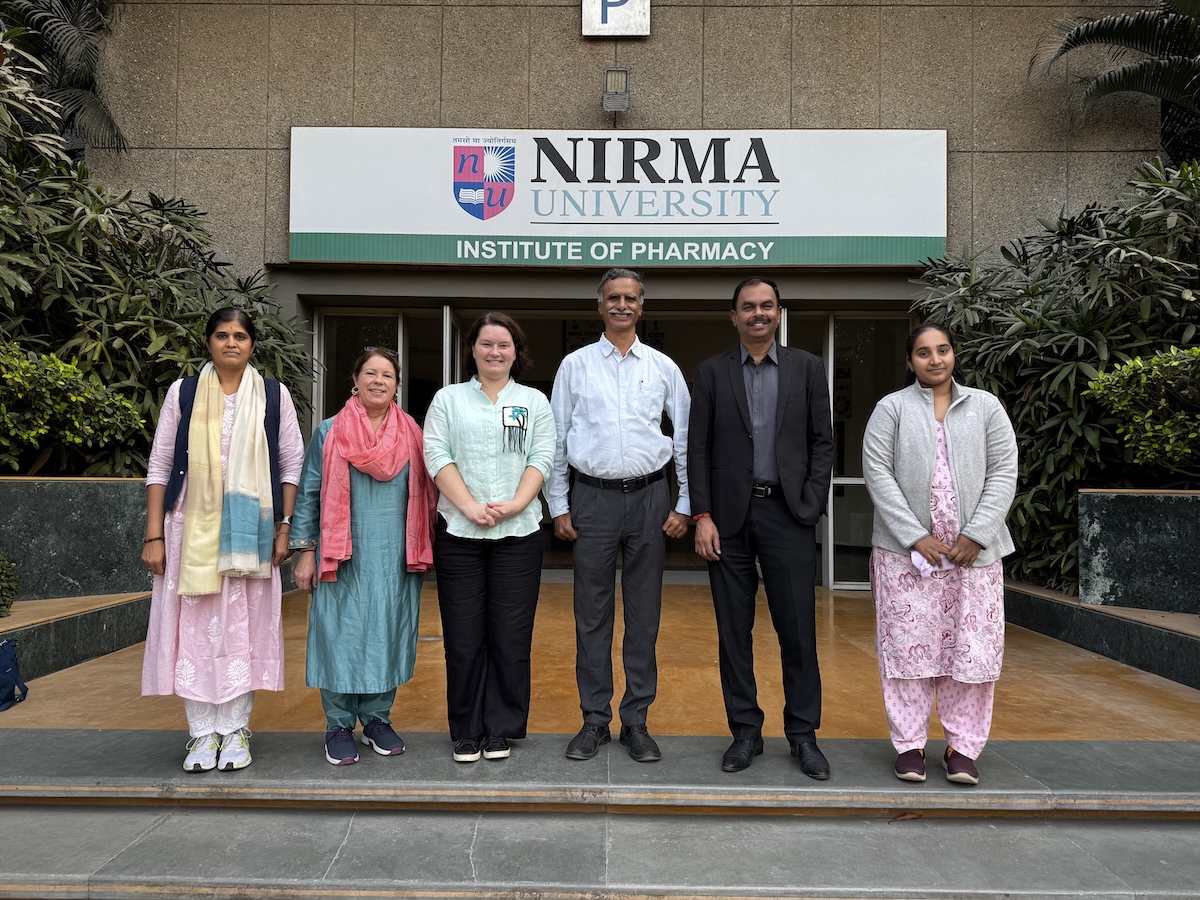
With support from its articulation agreement with Nirma University School of Pharmacy and funding from the Lois B. DeFleur International Innovation Fund, two faculty members visited India in January to deepen academic ties and create more international opportunities for pharmacy students.
Elizabeth Hageman, director of skills education and clinical assistant professor of pharmacy practice, said the initiative is part of a broader effort to expose students to global health systems.
“This is part of a larger outreach of understanding global health initiatives and global health challenges. By increasing our students’ exposure to another country’s healthcare system, it helps our students broaden their horizons and allows them to think outside of the box,” Hageman said.
Hageman and KarenBeth H. Bohan, professor of pharmacy practice, spent 10 days at Nirma University in Ahmedabad and at the Manipal Academy of Higher Education College of Pharmaceutical Sciences. During the visit, they shared curriculum overviews with faculty, toured local hospitals, met hospital administrators, pharmacists and students, and presented at the CPCON 2026 11th International Conference on Clinical Pharmacy. The conference focused on “Next-gen Clinical Pharmacy towards safer and more progressive patient care.”
Hageman said the international innovation award is designed to help faculty build global partnerships.
“The award is meant to be a seed fund for faculty to establish partnerships with people from abroad. That’s what I did with the Nirma University faculty — and we can now begin potentially collaborative research projects, get students involved, and share curriculum models to better understand how we can benefit from each other,” she said. “I think that the award is a steppingstone for developing research initiatives and long-term collaborative relationships. There’s a huge advantage to being able to meet people in person!”
She added that the collaboration also helps prepare students for working in diverse healthcare settings.
“We met with prospective students and parents that might be coming to Binghamton in the fall and beyond,” Hageman said. “But even beyond that, the United States healthcare system has many providers who come from other countries, and our graduating students need to be able to work with people who were trained elsewhere. When they go into healthcare, they are going to be working with physicians and other providers who were not trained in the U.S., so this exposure helps prepare them.”
Bohan, who previously established pharmacy collaborations in Uganda, said pharmacy education systems differ significantly between the United States and India.
“Here in the U.S., pharmacy coursework is governed by the Accreditation Council for Pharmacy Education (ACPE) … In India, however, it’s a prescribed curriculum. They also limit the number of students who can be enrolled and who can talk directly to physicians,” Bohan said. “When Nirma students enroll here, they get to see what collaborative practice can be. They are trained in our Pharmacy Skills Lab; they go on experiential rotations. When they go back, they will know what it’s like to be able to converse with other healthcare practitioners. And for our Binghamton students, I think these opportunities expose them to another culture.”
As part of the initiative, the faculty also organised a virtual exchange session through the course PHRM 551: Public Health and Global Health Problems. During the session, 26 students from Nirma University and 37 from Binghamton discussed healthcare topics such as diabetes treatment and the role of pharmacists in community pharmacies.
“The biggest thing, to us, is helping students understand that the way things work in the U.S. isn’t the same as all over the world,” Hageman said. “We had the students compare what happens here in the U.S. and what happens in India so they could have a conversation about the factors that impact these differences. I think it’s important for them to have a broader perspective of the world, and of global health in general.”
Looking ahead, the two faculty members plan to continue working with Indian partners on potential pharmacovigilance research projects and are preparing an abstract for presentation at an international conference in September.
“Even before I went to India for the first time, I was meeting online by Zoom with people from these universities. But going there in person is so much better,” Bohan said. “It helps solidify your relationship, and you can talk much more easily. Now that we’ve been to Nirma, it’ll be that much easier to collaborate. I’m excited to see what happens.”
About The Author