

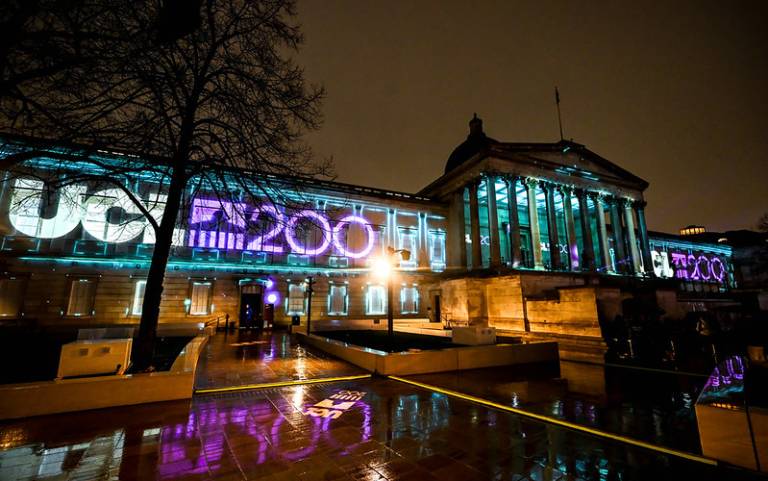
UCL President and Provost Dr Michael Spence said the university’s founding vision remains central to its mission today.
University College London (UCL) is marking 200 years since its founding, celebrating two centuries of academic innovation, social impact and global influence.
UCL was established on February 11, 1826, by a group of reform-minded intellectuals inspired by the ideas of philosopher Jeremy Bentham. At the time, the institution—then known as the “London University”—set out to be a modern and affordable alternative to the ancient universities of Oxford and Cambridge. It opened its doors to students in 1828.
Over the past two centuries, UCL has played a key role in breaking down barriers to education, producing world-leading research and shaping generations of influential thinkers. The university has been associated with major scientific discoveries and social progress that have transformed lives in the UK and beyond.
To mark the milestone, UCL will hold a year-long series of events throughout 2026 under the banner UCL200. The programme includes exhibitions, public lectures, festivals and cultural activities celebrating the university’s past, present and future.
UCL President and Provost Dr Michael Spence said the university’s founding vision remains central to its mission today.
“When our founders established UCL 200 years ago, they imagined a new kind of university—open to all, regardless of faith or background, and committed to using knowledge for the public good,” Dr Spence said. “That ethos still defines who we are.”

He added that UCL has grown into one of the world’s leading universities, working closely with communities and partners across the globe to address real-world challenges. “As we enter our third century, I am confident that the creativity and ambition of our community will help shape a better future for all,” he said.
Professor Dame Hazel Genn, UCL’s Pro-Provost for the Bicentennial, described the anniversary year as a chance to reflect and look ahead. “UCL continues to be a place of bold ideas and opportunity. This celebration honours our values and achievements while setting our sights firmly on the future,” she said.
The bicentenary celebrations begin with UCL Illuminated, a large-scale sound and light show at the university’s historic Quad and Wilkins Building. The immersive display uses 3D projection, music and storytelling to trace UCL’s journey from a small group of visionaries to a global centre for education and research. The performances, running from February 11 to 13, are sold out, but a free online livestream is available.
In addition, a major new exhibition titled Two Centuries Here has opened at UCL’s Bloomsbury campus. Spread across several campus spaces, the free exhibition explores the university’s history, impact and future through photographs, artefacts and interactive displays.
Among the highlights are a Crookes tube linked to the UK’s first clinical X-ray, a rocket nose cone connected to UCL’s space science research, and ancient Egyptian artefacts donated by writer and explorer Amelia Edwards.
About The Author